


TITLE: Maria Montessori, CALL NUMBER: LC-B2- 2925-9[P and P], REPRODUCTION NUMBER: LC-DIG-ggbain-14964 (digital file from original negative), No known restrictions on publication.
Digital ID: ggbain 14964 Source: digital file from original neg. Reproduction Number: LC-DIG-ggbain-14964 (digital file from original negative) Repository: Library of Congress Prints and Photographs Division Washington, D.C. 20540 USA.
MEDIUM: 1 negative : glass ; 5 x 7 in. or smaller. CREATED, PUBLISHED: [no date recorded on caption card.
NOTES: Title from unverified data provided by the Bain News Service on the negatives or caption cards. Forms part of: George Grantham Bain Collection (Library of Congress)
REPOSITORY: Library of Congress Prints and Photographs Division Washington, D.C. 20540 USA, DIGITAL ID: (digital file from original neg.) ggbain 14964 hdl.loc.gov/loc.pnp/, CARD #: ggb2005014968
MARC Record Line 540 - No known restrictions on publication

Maria Montessori M.D. unedited image
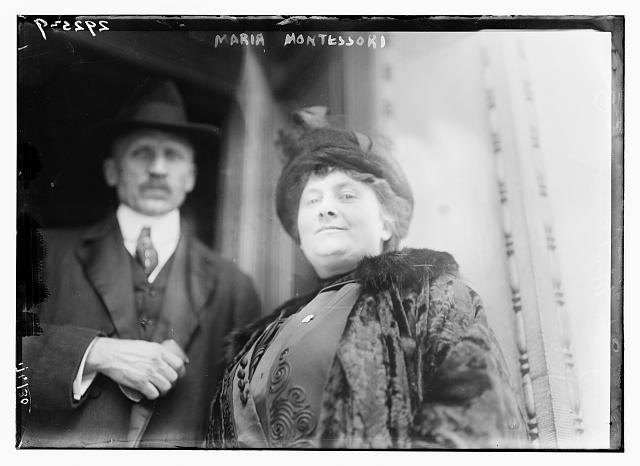
Credit Line: Library of Congress, Prints and Photographs Division, [REPRODUCTION NUMBER: LC-DIG-ggbain-14964]
In 1897, Maria Montessori joined the staff of the University of Rome as a voluntary assistant. One of her responsibilities is what led her to develop her educational philosophy. She was to visit asylums for the insane where she came across learning disabled children, unable to function in schools or families. Montessori found the children very responsive to doing work with their hands and bodies.
In 1901 she returned to the University of Rome with a desire to study the mind instead of the body. In 1904 she was offered a job teaching as the professor of anthropology at the University of Rome. She accepted but in 1906 gave the job up to work with sixty young children of working families. Her work was so successful that even learning disabled children began to pass examinations.
With these sixty children she started a "Children's House" in San Lorenzo Rome. This children's home was an environment that offered the children the opportunity to develop their activities. She began to notice how the children absorbed knowledge almost effortlessly from their surroundings which helped inspire her lifelong pursuit of educational reform.
This article is licensed under the GNU Free Documentation License. It uses material from the Wikipedia article, Montessori method.
Leave a comment, make a request, Let this small sampling be a guide to better quality, more plentiful, public domain, royalty free, copyright free, high resolution, images, stock photos, jpeg, jpg, free for commercial use, clip art, clipart, clip-art. more at Public Domain Clip Art and clip art or public domain Womens History Month or Women and Maria Montessori or University of Rome and anthropology or educational philosophy and children
Women's History Month, Maria Montessori M.D. editing by sookietex More about this image and story at Public Domain Clip Art - http://publicdomainclip-art.blogspot.com/2006/03/womens-history-month-maria-montessori.html





